Sector
Private hire vehicle rentalWhere
Cardiff & NewportBuilt
Web portal, own domainFleet
24 vehiclesThe problem
Twenty-four vehicles out on hire to private hire drivers across two cities, tracked in a single spreadsheet. Answering "who's got that Prius and when's it back?" meant scrolling, or ringing round. Rental agreements sat in a drawer as paper. Nobody could say what the week had actually taken without sitting down and adding it up — and the file broke the moment two people opened it at once.
What we built
A web portal on the company's own domain that opens on any phone or laptop.
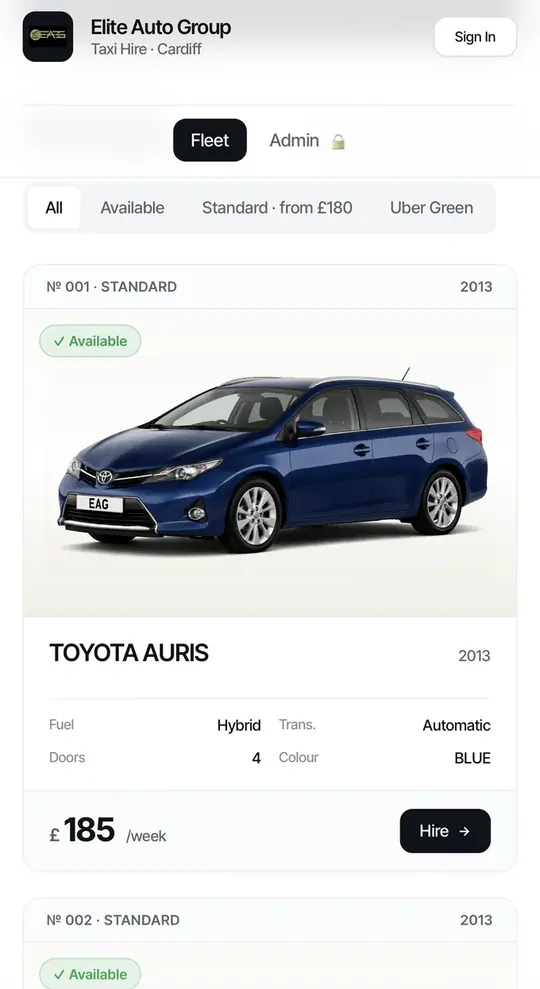
- Every vehicle on one board with a live status — on hire, available, or in for service — and who currently has it.
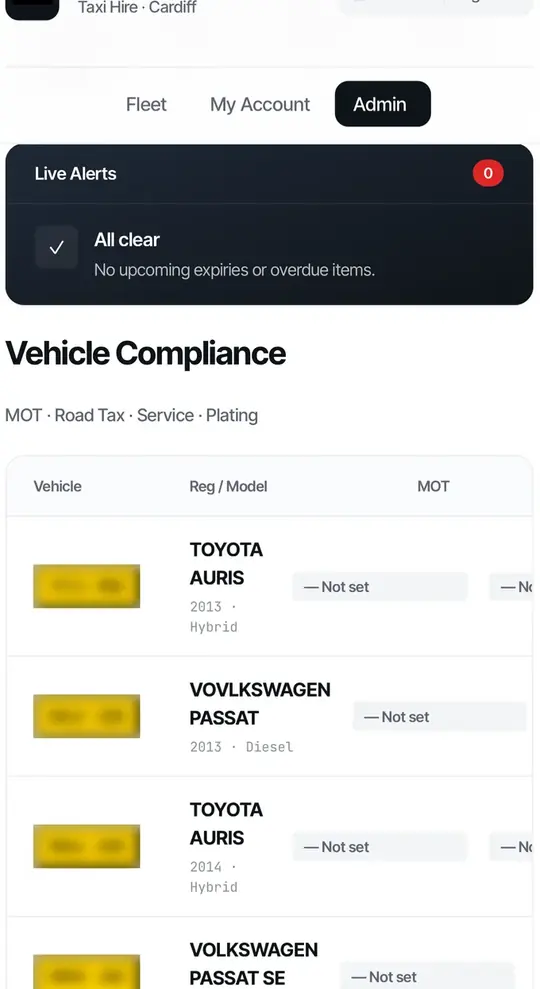
- Driver records holding licence, badge and insurance details, tied to the vehicle they're in.
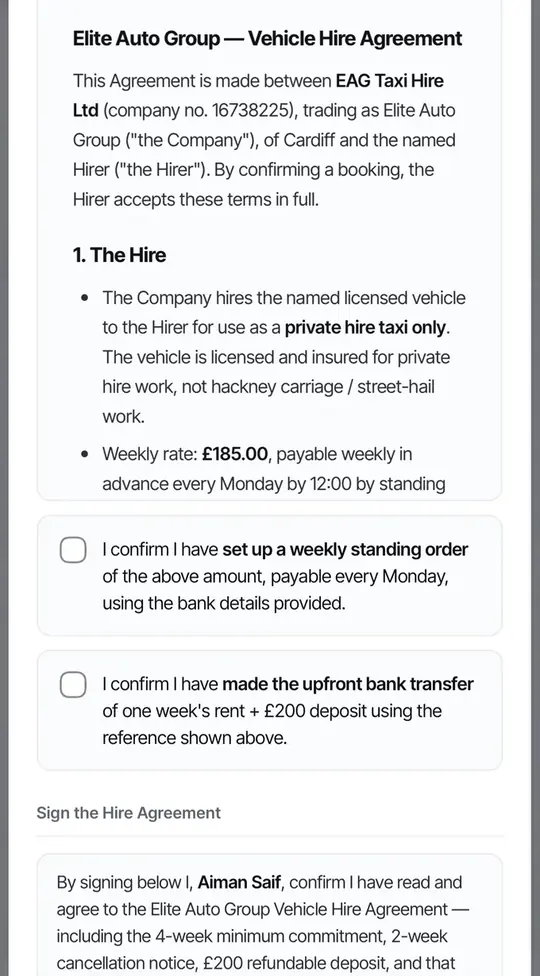
- Rental agreements created and stored in the system instead of on paper in a drawer.
- Weekly takings and utilisation on the front screen — how many of the 24 are earning today, and what they've brought in.
- Automatic email for the moments that matter, so nobody has to remember to send them.
Why we built it that way
It started as a prototype and was rebuilt properly before going live. The first version held everything in the browser — fine for proving the idea, useless for running a business, because clearing the browser would wipe the fleet. It was migrated onto a real database, with the schema hardened across twenty rounds of patches before a single real vehicle went near it.
Every permission is enforced at the database. A driver seeing only his own record isn't a screen that hides a button — it's a database rule that can't be got around. That distinction is the difference between looking secure and being secure, so it was tested by signing in as different drivers and confirming each one was walled off.
It runs on their domain, and they own all of it. Customers see Elite Auto Group in the address bar, not a software company. Every account, the database and the code are handed over — including revoking our own access keys — so it's genuinely theirs to keep.
Why it works
Fleet status is current all the time, not as of whenever the spreadsheet was last saved. The owner sees what's on hire and what the week has taken from his phone, without asking anyone. Every idle vehicle shows up the moment it's free — which is the entire point, because in a rental business the only thing that quietly loses money is a car sitting still. Before it went live it was put through more than sixty tests, with driver isolation checked hardest of all, because the fastest way to lose a fleet operator's trust is to show one driver another's details.
What we set out to do
Kill the idle car
Make every vehicle sitting off-hire visible instantly — an idle car is the only thing in this business that costs money without earning any.
Live on the front screenGet the data off one laptop
Move the fleet off a fragile spreadsheet onto a real database, so it can't be lost, corrupted, or locked to whoever last had the file open.
Migrated to SupabaseGive each driver their own view
Let drivers see their own vehicle and agreement and nothing else — enforced at the database, not just hidden on screen, so it holds up under scrutiny.
Row-level security, testedMake it their business, not ours
Run it on the company's own domain with their name in the address bar, and hand over every account and the code, so they never rent their own system back from us.
Live on their domainGet a fixed price
Tell us what you're still doing by hand.
Two lines is plenty. You'll get a real answer from a real person — including us saying so if we don't think you should spend the money.
- Replied to the same working day
- A written fixed price within 48 hours of a call
- No sales call, no drip emails, no chasing you afterwards